
From improving HIV treatment continuity to exploring artificial intelligence in tuberculosis diagnostics, seven AHRI scientists are contributing new knowledge to some of the most urgent health challenges in South Africa and achieving academic milestones. This year, two AHRI early career researchers completed PhDs and five earned master’s degrees from the University of KwaZulu-Natal.
For PhD graduate Dr Nsika Sithole, research and the lived realities of healthcare mobility went hand in hand. His doctoral work explored HIV treatment continuity among mobile populations in rural KwaZulu-Natal, highlighting how fragmented systems and disclosure challenges can disrupt care. His supervisor, Professor Mark Siedner, reflected on the innovation of his work: “Nsika’s research creatively shifts the focus from ‘failing’ patients to how the health system itself can meet people where they are to better support the continuity of care,” he said. Reflecting on his journey, Nsika described his PhD as representing “growth, persistence, and the power of mentorship.”

Dr Nsika Sithole
Fellow PhD graduate Dr Boitumelo Setlhare investigated the effects of South African traditional medicine on immune responses and HIV replication in laboratory models, contributing to growing interest in how traditional knowledge systems may inform biomedical innovation. Her supervisor, Prof Nceba Gqaleni, described her work as “highly innovative, opening new avenues for HIV treatment research.” Boitumelo reflected on a journey shaped by resilience, growth, and perseverance, dedicating her achievement to her late mother.

Prof Nceba Gqaleni, Dr Boitumelo Setlhare & Dr Mlungisi Ngcobo
Master’s graduate, Sabrina Isaac, examined how in-utero HIV exposure affects immune organisation in children, revealing important tissue-level immune changes that extend beyond blood-based studies. Her supervisor, Prof Henrik Kløverpris, noted that her work adds important insight into paediatric HIV and immune development.

Dr Faiaz Shaik Abdool & Sabrina Isaacs
Syethemba Nkosi explored behavioural factors influencing ART adherence among adolescents in uMkhanyakude District, highlighting the importance of adolescent-centred and context-responsive HIV interventions. “This study offers valuable insight into the lived realities influencing adherence among young people,” said his supervisor, Dr Nduku Wambua.
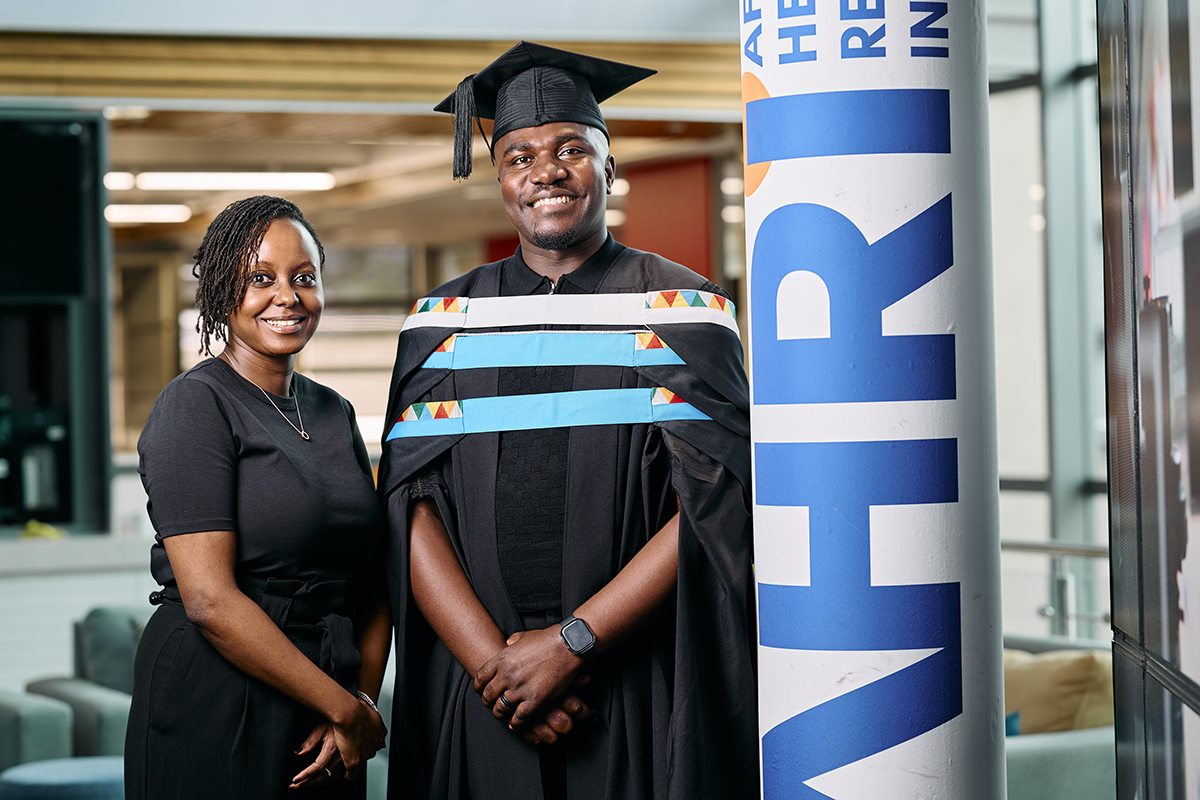
Dr Nduku Wambua & Syethemba Nkosi
Kapongo Lumamba’s research focused on computational pathology in tuberculosis, reviewing the use of machine learning in digitised lung tissue analysis for TB detection. “Kapongo’s work is a timely and critical perspective on the role of artificial intelligence in TB diagnostics,” said his supervisor, Prof Adrie Steyn.

Prof Adrie Steyn & Kapongo Lumamba
Sanyuktha’s master’s research investigated antibodies derived directly from TB-infected lung tissue to better understand immune responses to infection and identify potential targets for improved TB diagnostics and vaccines. Reflecting on the experience, she described the journey as both challenging and rewarding, shaped by resilience, patience, and persistence. “By investigating antibody responses directly within TB-infected lung tissue, Sanyuktha’s research provides important insight into host-pathogen interactions that could inform future diagnostic and vaccine strategies,” said her co-supervisors, Prof Al Leslie and Dr Robert Krause.

Dr Mark Chambers & Sanyuktha Harisingh
Nothando’s research compared T-cell immune responses induced by four Covid-19 vaccines in people living with and without HIV in Botswana, contributing valuable insight into vaccine-induced immunity in HIV-affected populations in sub-Saharan Africa. Reflecting on balancing her studies with major life changes, including motherhood, she shared her hope that her journey would encourage other women to believe that becoming a wife or mother does not mean putting your dreams on hold. Her co-supervisor, Dr Tiza Ng’uni, praised her dedication and perseverance, describing her achievement as a beautiful reflection of hard work and resilience.

Prof Zaza Ndhlovu, Nothando Guliwe and Dr Tiza Ng’uni
Together, their work highlights the value of interdisciplinary, locally relevant research in advancing our understanding of HIV, TB and Covid-19 in South Africa.
AHRI is proud to celebrate these graduates and their growing contribution to the future of health research.